![]() ![]() ![]() ![]() ![]() ![]() ![]() ![]() |
||||||||||||||||||||||||||||||||||||||
|
|
|
||||||||||||||||||||||||||||||||||||
| THE HISTORY OF SUN-MAR IS
THE HISTORY OF COMPOSTING TOILETS What SUN-MAR Composting
Toilets do SUN-MAR composting toilets
recycle waste on-site by evaporating the liquids, and converting the solids to
a fertilizing soil which is perfect for uptake by plants. SUN-MAR composting
toilets use naturally occurring aerobic bacteria to convert the carbon atoms in
the waste to carbon dioxide, and the hydrogen atoms to water. In this way the
waste is oxidized and reduced to its essential minerals. Since waste is some
95% moisture, after the liquid has been evaporated and the solid waste
composted, the residual is only about 3% of the starting volume. This recycling process avoids the need for
sewers and central treatment plants. It also avoids invasive on-site treatment
systems such as septic systems. SUN-MAR composting toilets
are recycling marvels that are odorless, leave no footprint, do not pollute in
any way, and can be installed anywhere a toilet is needed. Indeed a SUN-MAR is
so obviously good for the planet that at SUN-MAR we wonder why everyone is not
using them! The First Generation
Waterless Composting Toilet The founder of SUN-MAR, Hardy
Sundberg, developed the first self contained composting toilet in 1971. This
waterless toilet had a fan and heater at the top, blowing hot air onto the
waste pile which was agitated by mechanical mixers. As the compost in the
bottom was agitated it fell though a screen into a collection chamber. While at the time this toilet
represented a big step forward in the development of composting toilets, in
hindsight it can be seen to suffer from a number of weaknesses. Firstly, this
composting toilet design was what we now call a single chamber unit, which
means that the operating conditions were the same throughout the whole toilet
and not optimized for the different needs of composting, evaporation or
finishing. Secondly, the fact that heat was being blown in from the top meant
that the compost tended to get dried out, while the liquid in the bottom was
not evaporated efficiently. Thirdly, the compost in the bottom was not isolated
and was subject to contamination from fresh waste. Even today, over 30 years
later, some waterless composting toilets can still be found which feature a top
mounted heater with all the attendant problems this brings. However, subsequent
SUN-MAR composting toilet designs have been successful in solving the inherent
problems evident in this first waterless toilet design. The Second Generation In 1977, the second
generation composting toilet was born. Known as the Tropic, this waterless
toilet featured one highly significant improvement;-
the heater was located in a sealed compartment in the base of the toilet. This
base heater was able to evaporate the excess liquid in the base, while allowing
the compost pile to remain moist, an improvement which dramatically increased
composting speed and ease of operation This heater arrangement
therefore overcame the big problem with top mounted heaters, namely that in
evaporating liquid they also dry out the compost pile. Drying out the pile has
two undesirable affects. Firstly, aerobic microbes are reduced to the point
where composting slows to a halt, and secondly the waste cakes to a consistency
somewhat like an adobe brick where it becomes impossible to agitate the pile. The First Central
Composting Toilet System was Marketed In 1977 SUN-MAR extended the
concept of domestic composting by offering a composting toilet system that was
outside and several feet away from the bathroom, but connected to a 1 pint toilet
in the bathroom. This allowed users to have a ”normal”
looking bathroom, while still having all the benefits of composting. The use of
a low flush toilet meant that compost was much easier to keep moist. However
because this toilet was not waterless, it was not always possible to evaporate
all the liquid. Consequently, the small amount of excess liquid has to be
handled by an old septic, recycling bed, or other approved system. The Third Generation In 1979, a further major
improvement was launched. The difficulty of aerating, and providing oxygen for
the aerobic microbes was solved by replacing the pile and mechanical mixers by
a Bio-drum. The Bio-drum had a door which when open allowed the waste into the
Bio-drum, and when shut allowed the Bio-drum to stay sealed when rotated. This
Bio-drum arrangement gave rise to a huge performance improvement because by
rotating the drum compost could now be well mixed, and perfectly oxygenated,
while also allowing the moisture to be evenly distributed throughout the
compost. This Bio-drum had a screen in
the rear, which allowed any excess liquid to drain into the evaporating chamber
in the base of the composting toilet, thus ensuring the waste did not get
saturated. Saturated waste is undesirable in a composting toilet because it
dramatically slows composting down by driving out the oxygen the aerobic
microbes need to survive. A saturated compost provides
good conditions for anaerobic microbes, which are slow and odorful. Another major benefit to the
Bio-drum arrangement was that by rotating the Bio-drum backwards, the Bio-drum
door would remain open so that the compost would drop automatically into a
finishing drawer. In the drawer, compost was isolated, no longer exposed to
fresh waste, and was able to finish composting while gradually drying out. The
drawer could be easily removed without exposing the user to liquid or fresh
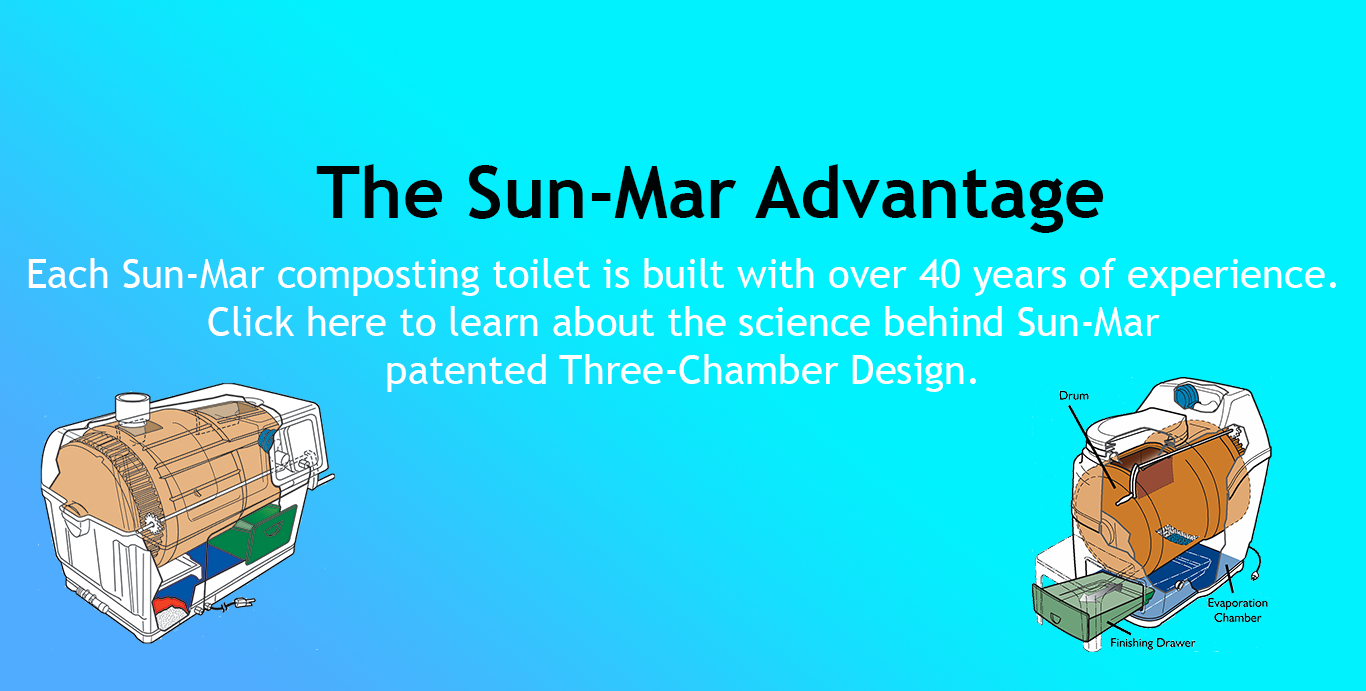
waste. This was the first three
chamber composting toilet, where composting was taking place in the Bio-drum,
liquid was being evaporated in the evaporating chamber and compost was being
finished in a finishing drawer. All these essential processes could now be
optimized, a development which gave SUN-MAR the leadership position in the
field of composting toilets,- one which it has maintained to the present
day The Advantages of a Three
Chamber Composting Toilet Some of the advantages have
been described above. Hopefully repetition will do no harm! 1. The three different
chambers allow for optimizing the three different requirements for composting,
evaporating and finishing. 2. The Bio-drum allows
compost to be properly and completely oxygenated, rather than the partial
aeration achieved by composting toilets with fixed mechanical mixers. 3. The Bio-drum ensures there
is no excess moisture, since any excess is automatically drained to the
evaporating chamber. 4. By being separated from
any direct heat, the material in the drum does not dry out as it would in
composting toilet designs where heat is aimed directly at the pile 5. The drum offers simplicity
of operation. Tumbling the Bio-drum ensures mixing is easy and complete,.( like a cement mixer or clothes dryer) 6. Removing compost is merely
a question of rotating the Bio-drum backwards. There is no concern with sealed
bases, secured by screws and thee is no exposure to liquids and flooding 7. The Bio-drum offers the
ideal environment for aerobic bacteria to prosper 8. The evaporating chamber is
heated by a heater below it. The advantage this gives is similar to the
advantage gained by heating a saucepan with an element beneath, as opposed to
heating with a hair dryer from above. 9. The heater is on when
there is liquid to evaporate and off most of the time when there is no liquid. 10. The evaporating chamber
offers the ideal environment for evaporation with air being pulled by a fan
over a large surface area of liquid warmed from beneath. 11. While in the drawer the
compost is surrounded by a stream of drying air, and gradually dries out prior
to removal rather than being exposed to, and contaminated by, fresh waste and
liquid. 12. The drawer is removed
merely by pulling it out by hand The First Self-contained
Non Electric Waterless Composting Toilet So successful was the 3
chamber concept that in 1981 SUN-MAR introduced the first self-contained non-electric
composting toilet. This was identical to the electric unit of its time, except
for a few important differences: 1. The non-electric toilet
had a 4" vent stack rather than the 2" vent on electric units 2. There was no fan on the
non-electric unit, although a 12V fan could be inserted in the vent stack if
additional air movement was needed. 3. There was no heating
compartment in the base of non-electric toilets 4. The non electric
composting toilet had a larger drain than the emergency safety drain on
electric units This concept proved so
successful that SUN-MAR’s non-electric composting
toilet remains the standard for those living off the grid. The First Non-electric
Central Composting Toilet System In 1987, SUN-MAR offered the
first Non-electric Central Composting Toilet System. This unit incorporated
similar differences that distinguished the non-electric self-contained toilet,
namely a 4" vent stack with 12V fan, and no heating compartment in the
base The First Self contained
Composting Toilet to Pass North American Operating Standard In 1989 SUN-MAR’s Excel became the first self-contained composting
toilet to pass the National Sanitation Foundation (NSF) Standard #41. This was
a 6 month residential test where no odor was permitted even under overload
conditions, and only a negligible fecal coliform
count was permitted in the composted output. This meant that from 1989
regulators could confidently permit use of a waterless SUN-MAR composting
toilet. Today, SUN-MAR composting
toilets are the only such toilets listed and certified by NSF under the new
updated NSF Standard #41 (1999) for
residential and for cottage use. The First Dual-vented
Waterless Composting Toilet In 1991 Sun-Mar introduced a
dual vented self-contained composting toilet, which operated as an electric
unit when power was available, but defaulted to non-electric operation using
the 4" vent stack when it was not. This model proved to be popular for
those who had no power now but were expecting it in the future; for those operating
a generator for most, but not all the time; and for those with an insecure
power supply. 1993 The Compact and the
Centrex are launched 1993 was a big year for
SUN-MAR. At this time the Compact and Centrex models were both launched. The Compact was a lower
profile version of the long established Excel. It had a patented variable
diameter Bio-drum and an elegant look which made this waterless composter at
home in any bathroom. The Centrex was an all new
Central composting unit with a Bio-drum slung side to side rather than for and
aft. This allowed for a lower profile making it easier to be fit into places
where there is little headroom. In addition to the regular 1 pint flush
version, this configuration also allowed SUN-MAR to offer a waterless Central
unit which featured a SUN-MAR Dry Toilet positioned directly above the
composting unit. In addition, the new design
lent itself to being scaled up, an advantage which was to result in the
subsequent launching of the Centrex 2000 and 3000 series units The First Composting
Toilet Designed Specifically for The SUN-MAR Mobile,
introduced in1994 was the first waterless, self-contained composting toilet
designed for use in marine and RV markets, and for that matter, for use in
anything that moves. The key feature of the mobile unit was that at only
19" wide it could be installed virtually anywhere. Other than the width, what
was new in this composting toilet was the 3" vent stack with a special
fan/filter box which scrubbed the vented air so as to avoid any inconvenience
on deck. In addition the finishing drawer was gasketed
in place so that liquid could not escape even during violent motion, and the
footrest folded back into the unit which is only 23" deep. In addition a shore based
waterless composting toilet was introduced with a 2" vent with a special
fan assembly, and a 160 watt heater in the base compartment. This unit, the Spacesaver, is ideally suited for installation in cupboards
or small corners where a toilet is needed but space is a problem. The Centrex 3000, the
First Continuous Flow Composting Toilet System In 1997 SUN-MAR unveiled the
first continuous flow central composting toilet system. This meant that as the
Bio-drum rotates compost moves along and through the unit before falling
automatically into a collection chamber at the end of the unit. On this unit,
the high capacity 3000,
the collection chamber replaces the finishing drawer as the 3rd
chamber. This unit is the highest capacity Composting toilet system in SUN-MAR’s line and has been subject to continuous improvement
since its introduction. It is available in either waterless or 1 pint flush
configurations, and in electric, non-electric and dual vented versions. The Mid Capacity Centrex
2000 The last new major family of
Central Composting toilet systems, the Centrex 2000, was SUN-MAR’s millennium baby, born in 2000. This unit was designed
as a medium to high capacity composter suitable for residential use and for
heavy cottage use. In fact its Bio-drum is so large that most families only
have to remove compost on an annual basis. Despite its high capacity the 2000
is a low profile unit which fits into spaces with limited headroom. Like the
3000, it is offered in waterless or 1 pint flush versions, and in electric,
non-electric and dual vented models. | ||||||||||||||||||||||||||||||||||||||